El desencanto de Argentina: la imagen negativa de Javier Milei alcanza ya el 60%
(LPL/EN) – Malos vientos para el gobierno de Argentina. La imagen del presidente Javier Milei se desploma y su
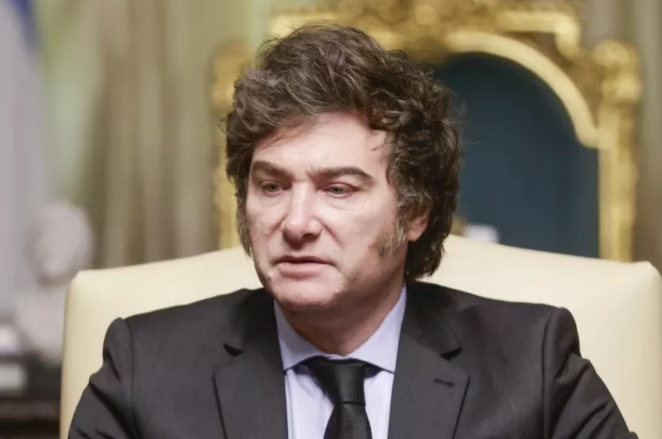
(LPL/EN) – Malos vientos para el gobierno de Argentina. La imagen del presidente Javier Milei se desploma y su mala reputación supera ya el 60%. Su jefe de Gabinete, Manuel Adorni, no logró salir esta semana con la cabeza alta de su comparecencia en el Congreso, donde evitó dar respuestas sólidas, o convincentes, a las acusaciones de enriquecimiento ilícito, aumento de patrimonio y uso indebido del avión presidencial.
La secretaria general de la Presidencia y hermana del jefe del Estado, Karina Milei, tampoco supera la prueba de la credibilidad entre una población que quiere resultados sobre las denuncias de corrupción en la Agencia Nacional de Discapacidad (ANDIS) donde ella está en primera línea de fuego. También sigue coleando el caso de la criptomoneda Libra que sacudió –y sacude– a Javier Milei por promocionar una inversión, de la que se arrepentiría, que se convirtió en un meme para los que creyeron en ella.
El presidente libertario generó una ilusión de cambio y esperanza entre los argentinos, –que volvieron a darle un voto de confianza el pasado mes de noviembre en las elecciones legislativas–, pero eso, al menos en los últimos sondeos, ha cambiado.
La consultora Zentriz adjudica una imagen negativa a Milei del 59,3 % y un 60,6 % de desaprobación a su gestión en el mes de abril, el mismo en el que estallaron los escándalos de Adorni, al que los dos hermanos Milei mantienen firme en su puesto. El trabajo demoscópico arroja un dato preocupante; el 57,3 % de los consultados percibe una corrupción generalizada en la gestión de gobierno.
Faltan menos de dos años para las elecciones presidenciales y estos datos no parecen buenos. Otra consultora los ratifica y profundiza, la brasileña Atlas-Intel realizó un estudio entre quince líderes de Argentina, que publica el diario La Nación, en la misma dirección.
La ultraizquierda está mejor vista
El presidente Milei quedó relegado a un quinto puesto con una imagen negativa superior al anterior sondeo: 62% . Lo sorprendente es que las tres figuras políticas que se alzan en el podio como los mejor valorados son de extrema izquierda, como Myriam Bregman; Axel Kicillof, exministro de Economía de Cristina Fernández y actual gobernador de Buenos Aires que estuvo en Barcelona en «el guateque» de la Global Progressive Mobilisation, de Pedro Sánchez y la propia viuda de Néstor Kirchner condenada por corrupta.
Los tres, por este orden, tienen mejor imagen que Milei y la negativa no supera en la primera el 46 %, en el segundo el 49% y en la expresidenta el 53%. Todos muy por debajo de ese 62 % del presidente de Argentina. Dicho de otro modo, a los tres, los argentinos los ven con mejores ojos que a Milei.
¿Qué ha pasado? «La carta más fuerte del gobierno, el control de la inflación, comienza a percibirse fuera de control. Esto afectó a su imagen y explica la fuerte caída en las encuestas», observa en su informe quincenal Contexto Político, de la consultora Starkelabs.
El equivalente al IPC de las dos últimas semanas es del 3,4% hay un 2,1% de caída de actividad y el índice de Confianza del Consumidor es del 33,64%, según datos oficiales del INDEC (Instituto Nacional de Estadísticas y Censo). En dos años de gobierno se han cerrado más de 20.000 empresas, según datos oficiales de la Superintendencia de Riesgo del Trabajo.
El efecto en el ánimo de los argentinos salta a la vista: «La sensación de estancamiento económico y el aumento de la incertidumbre por parte de la gente afectan el humor social en general».
Aquellas banderas de acabar con «la casta» y meter la motosierra hasta al médula de la corrupción parecen haberse oxidado en apenas dos años.
Lo que se mantiene vivo, y tampoco induce a pensar que ayuda al Ejecutivo, es su abierta declaración de guerra a los periodistas argentinos. El presidente prohibió la entrada a la Casa Rosada a la prensa acreditada que trabajaba a diario en sus instalaciones. La difusión de unas imágenes de la sede del Ejecutivo más cinematográfica, junto a la Casa Blanca, le sirvió de excusa a la Presidencia para justificar una decisión sin precedente.
La versión oficial asegura que se hicieron sin permiso, la de la periodista Luciana Geuna es que «avisamos con anterioridad a los responsables de prensa». En cualquier caso, lo que se vio en el programa fueron «espacios comunes» abiertos y «pasillos» de libre circulación.
La obsesión de Javier Milei con la prensa supera casi a la que tuvo el matrimonio Kirchner con el grupo Clarín. «Dijeron barbaridades de mi, de mi familia y de mis hijitos de cuatro patas [los perros]», protestó el presidente esta semana.
English:
Argentina’s Disillusionment: Javier Milei’s Negative Approval Rating Hits 60%
(LPL/EN) – Ill winds are blowing for the Argentine government. President Javier Milei’s public image is plummeting, and his negative approval rating has now surpassed the 60% mark. His Chief of Staff, Manuel Adorni, failed to emerge with his head held high from his congressional hearing this week, where he sidestepped providing solid—or even convincing—answers regarding accusations of illicit enrichment, unexplained increases in personal wealth, and the improper use of the presidential aircraft.
The Secretary General of the Presidency—and sister of the Head of State—Karina Milei, is likewise failing the credibility test among a population demanding concrete results regarding corruption allegations at the National Disability Agency (ANDIS), where she currently finds herself directly in the line of fire. Also continuing to linger is the «Libra» cryptocurrency scandal, which rocked—and continues to rock—Javier Milei for having promoted an investment—one he would later come to regret—that ultimately became a running joke among those who had put their faith in it.
The libertarian president had initially sparked a sense of hope and the promise of change among Argentines—who, as recently as last November’s legislative elections, had renewed their vote of confidence in him—but that sentiment, at least according to the latest opinion polls, has now shifted.
The consulting firm Zentriz assigns Milei a negative approval rating of 59.3% and a job disapproval rating of 60.6% for the month of April—the very month in which the scandals surrounding Adorni erupted, yet during which both Milei siblings have steadfastly kept him in his post. The survey data reveals a particularly troubling statistic: 57.3% of respondents perceive widespread corruption within the current government administration.
With less than two years remaining until the next presidential election, these figures do not bode well. Another consulting firm has corroborated and further underscored these findings: the Brazilian firm Atlas-Intel conducted a study assessing fifteen prominent Argentine leaders—the results of which were published by the newspaper La Nación—yielding results that point in the exact same direction. The Far Left Is Viewed More Favorably
President Milei has been relegated to fifth place, with a negative approval rating higher than in the previous poll: 62%. What is surprising is that the three political figures standing on the podium as the most highly rated belong to the far left—specifically Myriam Bregman; Axel Kicillof (former Minister of Economy under Cristina Fernández and current Governor of Buenos Aires, who attended the «shindig» hosted by Pedro Sánchez’s Global Progressive Mobilization in Barcelona); and Néstor Kirchner’s own widow, who has been convicted of corruption.
These three—in that specific order—enjoy a more favorable public image than Milei. Their negative ratings do not exceed 46% for the first figure, 49% for the second, and 53% for the former president—all well below the 62% negative rating held by Argentina’s current president. In other words, Argentines view these three figures more favorably than they do Milei.
What has happened? «The government’s strongest card—the control of inflation—is beginning to be perceived as spiraling out of control. This has damaged its public image and explains the sharp drop in the polls,» notes Contexto Político—the biweekly report produced by the consultancy firm Starkelabs—in its latest analysis.
The equivalent of the Consumer Price Index (CPI) for the last two weeks stands at 3.4%; economic activity has contracted by 2.1%; and the Consumer Confidence Index sits at 33.64%, according to official data from INDEC (the National Institute of Statistics and Census). Furthermore, over 20,000 businesses have closed their doors during the administration’s two years in office, according to official figures from the Superintendence of Occupational Risks.
The impact on the Argentine public’s morale is glaringly obvious: «The pervasive sense of economic stagnation, coupled with rising public uncertainty, is negatively affecting the general social mood.»
Those rallying cries to dismantle «the caste» and wield the «chainsaw» to cut corruption down to the very bone appear to have rusted away in a mere two years.
What does remain alive—though it hardly seems to benefit the Executive branch—is its open declaration of war against Argentine journalists. The President barred accredited journalists—who worked daily within its premises—from entering the Casa Rosada. The broadcast of footage featuring the Executive Branch’s headquarters—arguably the most cinematic such seat of power, alongside the White House—served as the Presidency’s pretext for justifying this unprecedented decision.
The official account asserts that the footage was captured without permission; journalist Luciana Geuna, however, maintains that «we notified the press officials in advance.» In any case, what was shown on the program consisted of open «common areas» and «hallways» where movement is unrestricted.
Javier Milei’s obsession with the press nearly rivals the fixation the Kirchner couple once held regarding the Clarín Group. «They said outrageous things about me, about my family, and about my little four-legged children [my dogs],» the President complained this week.